What Changed in the January 2026 Ranked Season
The extra-star bonus fundamentally alters progression math. Standard matches award 1-3 stars for wins, deduct 1-2 for losses. The sprint bonus adds +1 star regardless of outcome, transforming risk-reward calculations.
At peak efficiency (6:00-10:00 PM UTC+8), queue times drop to 30-60 seconds, enabling 5-7 matches per hour. A 55% win rate yields 2.55 stars/hour normally. The sprint doubles this to 5.1 stars/hour, cutting progression time nearly in half.
Completing party goals during the sprint awards 30 Commemorative Tickets plus one Ranked Party Protection Card.
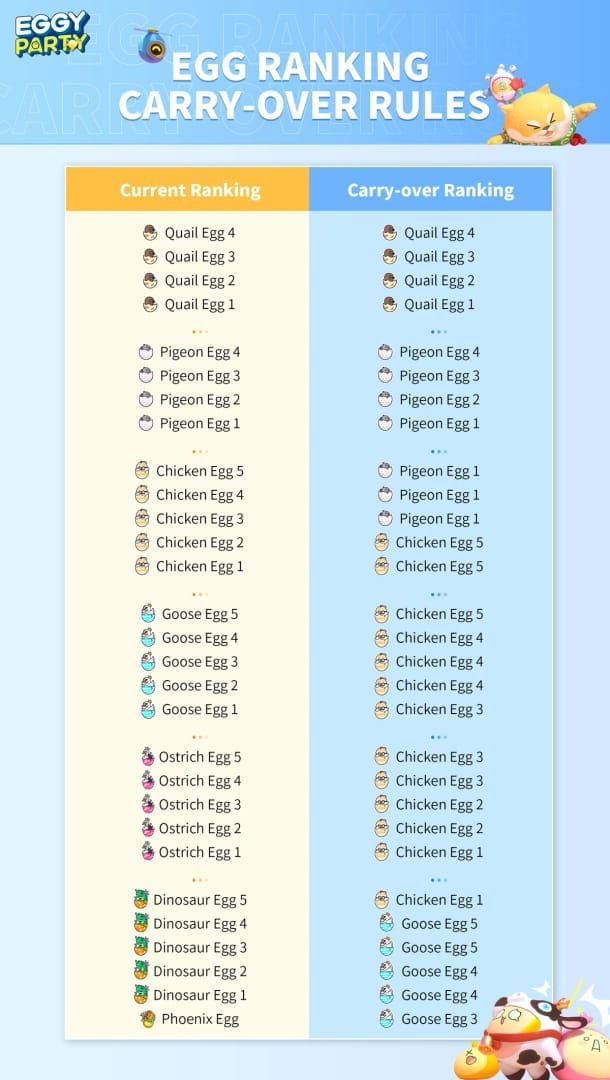
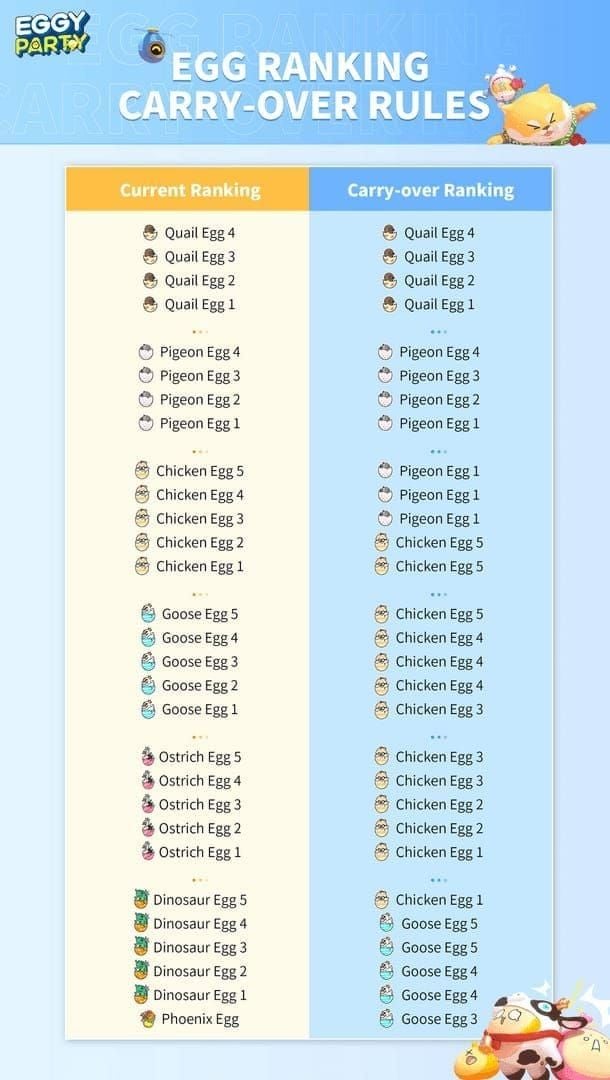
Phoenix Egg Rank: Requirements and Exclusive Rewards
Phoenix Egg is Eggy Party's competitive pinnacle. Reaching it from Bronze requires 400-500 total stars:
- Bronze-Silver sub-tiers: 15-20 stars each
- Gold-Platinum sub-tiers: 20-25 stars each
- Diamond sub-tiers: 25-30 stars each
Win rates by tier: Bronze-Silver (45-50%), Gold-Platinum (52-55%), Diamond (58-60%).
Phoenix Egg grants exclusive cosmetics, priority matchmaking, and permanent seasonal recognition badges. Its prestige stems from exclusion from the extra-star sprint bonus—you must achieve it through standard progression before season end.
Star Point System Overview
Star calculations weigh match outcome, individual contribution, and streak bonuses:
- Match result: Base 1-3 stars for wins, -1 to -2 for losses
- Performance metrics: Survival time, eliminations, objective completion
- Win streak multipliers: Consecutive victories increase star awards
The sprint adds a flat +1 star to every Ranked Party match, stacking multiplicatively. A three-star win becomes four stars; a two-star loss becomes one star, significantly reducing downside risk.
Ranked Party matches last 8-12 minutes, making them more time-efficient than Hype Arena Ranked's 15-20 minutes.
The Extra-Star Window Mechanic Explained
What Triggers the Extra-Star Window
The bonus activates automatically for every Ranked Party match played January 2-8, 2026 at 23:59 UTC+8. No special conditions, performance requirements, or preliminary matches needed. Just queue for Ranked Party during this window.
Excludes Phoenix Egg Rank players to prevent top-tier inflation. If you reach Phoenix Egg during the sprint, subsequent matches lose the bonus, though you keep all progress earned while climbing.
This differs from win streak bonuses or performance multipliers requiring specific achievements. The extra-star window rewards participation and consistency, making it accessible across skill levels.
Duration and Frequency
The sprint operates continuously for 168 hours (seven days) from January 2 at 00:00 UTC+8 through January 8 at 23:59 UTC+8. No daily resets, cooldowns, or match limits.
At peak efficiency (6-7 matches/hour during prime time), a dedicated player could complete 42-49 matches in a single seven-hour session.
This is a one-time event for Season 14. Missed opportunities can't be recovered. Unlike weekly events, the End of Season Sprint represents a singular progression window before the January 9 reset.
How Extra-Star Bonuses Stack with Win Streaks
Win streak bonuses and extra-star mechanics stack additively. A standard three-star victory with active streak bonuses becomes four stars during the sprint.
Example: A Diamond-tier player on a five-game win streak might earn three base stars due to performance and streak bonuses. The sprint adds one more, yielding four total stars per match. Over ten consecutive wins, this generates 40 stars instead of 30—a 33% increase.
Loss mitigation also improves. A typical two-star loss becomes one star with the sprint bonus, effectively halving the penalty. This reduced downside risk encourages aggressive ranking attempts.
Common Misconceptions
Myth 1: The extra-star window requires activation through achievements or purchases.
Reality: It applies automatically to all eligible matches without prerequisites beyond playing during the event timeframe.
Myth 2: The bonus stops working before Phoenix Egg.
Reality: Diamond I players receive the full bonus until they actually promote to Phoenix Egg.
Myth 3: The bonus applies to all ranked modes.
Reality: The End of Season Sprint targets Ranked Party matches only. Hype Arena Ranked, Fright Night Escape Ranked, and Ebby Battle Ranked don't receive the extra-star multiplier, though they benefit from Snow Fest protection during the December 31-January 4 overlap.
Advanced Techniques to Abuse the Extra-Star Window
Session Timing Strategy
Peak hours (6:00-10:00 PM UTC+8) deliver highest match frequency and balanced matchmaking. Queue times drop to 30-60 seconds, enabling 5-7 matches/hour—a 40-60% efficiency increase vs. off-peak periods (2-3 minute queues).
For different time zones: UTC+0 reset at 4:00 PM, UTC-5 reset at 11:00 AM. Playing immediately after reset provides fresher matchmaking pools with less experienced players.
Weekend availability (January 4-5, 2026) coincides with Snow Fest protection's final days and the sprint window. This overlap creates the optimal 48-hour period for aggressive ranking pushes.
Weekend Hustle event (January 5-11, 2026) extends beyond the sprint but awards one additional Ranked Party Protection Card. Coordinate this reward with your final sprint push on January 7-8 for emergency protection.
Performance Threshold Manipulation
While the extra-star bonus applies universally, optimizing match performance maximizes base star awards that stack with the sprint multiplier. Focus on survival-oriented strategies prioritizing consistent top-half finishes over high-risk elimination attempts.
In Ranked Party, objective completion contributes significantly to performance ratings. Prioritize checkpoint captures, team revivals, and obstacle course efficiency over pure speed. A fourth-place finish with high objective participation often awards more stars than second place with minimal contribution.
Team composition affects performance indirectly through win probability. Queuing with coordinated teammates during peak hours increases win rates by 8-12% vs. solo queue, translating to 0.4-0.6 additional stars/hour.
Map rotation knowledge allows selective queue timing. If you excel at platforming-heavy courses, queue during rotations featuring those maps to increase performance rating and base star awards before the sprint multiplier applies.
Map Selection Impact
The extra-star bonus applies regardless of map, but map selection influences base star awards through performance variance. Shorter maps (8-9 min average) allow more matches/hour, while longer maps (11-12 min) provide more opportunities for performance-based star bonuses.
Optimal strategy: During the sprint's final 48 hours (January 7-8), prioritize shorter maps to maximize total matches and extra-star applications. During initial days (January 2-4) when Snow Fest protection remains active, longer maps allow safer experimentation with higher base star potential.
Map-specific win rates vary by 5-8% based on course mechanics. Track your personal map statistics and queue preferentially during rotations featuring your strongest maps. This selective queuing can improve overall win rates from 52% to 57%, generating approximately one additional star per three matches.
Win Streak Preservation
Win streaks amplify the extra-star bonus's value by increasing base awards before the multiplier applies. A five-game streak might elevate a two-star win to three stars, which becomes four stars with the sprint bonus—a 100% increase over a non-streak, non-sprint match.
Preserve streaks by recognizing fatigue patterns. Performance typically degrades after 90-120 minutes of continuous play. Schedule 15-minute breaks between sessions to maintain decision-making quality.
If you're one loss away from breaking a significant streak (5+ games), consider using a Protection Card even during the sprint. The card preserves both your streak multiplier and prevents star loss, effectively generating a 3-4 star swing vs. an unprotected loss.
Queue discipline matters. Avoid queuing during off-peak hours (2:00-6:00 AM UTC+8) when matchmaking quality degrades and unpredictable player skill variance increases.
Protection Card Complete Guide
Types of Protection Cards
Eggy Party offers a single Protection Card type for Ranked Party mode. Each card prevents star loss from a single defeat, preserving your current rank and any active win streak bonuses.
The card displays as a shield icon in your inventory with a counter showing remaining protected matches. Cards don't expire based on time—they remain until actively consumed during a match loss.
How to Acquire Protection Cards Efficiently
End of Season Sprint: Awards one Ranked Party Protection Card upon completing party goals during January 2-8.
Snow Fest (December 31, 2025 - January 4, 2026): Provides 12 protected matches daily across four ranked modes, totaling 60 protected matches over five days. While these aren't inventory cards, they function identically—the first three matches per mode daily receive automatic protection (shield icon).
Weekend Hustle (January 5-11, 2026): Awards one additional Ranked Party Protection Card for completing weekend-specific objectives.
Players seeking additional cards can efficiently recharge through BitTopup's platform, which offers competitive pricing and instant delivery for Eggy Coins. The buy Eggy Coins recharge service enables quick resource acquisition without interrupting ranking momentum.
Protection Card Inventory Management
Maintain a 2-3 card reserve for emergencies while actively deploying cards during high-value matches. Hoarding excessive cards (5+) reduces utility, as the season reset on January 9 may devalue unused protection.
Track consumption rate against remaining sprint days. If you're using more than one card/day during January 2-4 (when Snow Fest protection is active), you're deploying suboptimally. Reserve inventory cards for January 5-8 when Snow Fest expires.
Consider distance from next rank threshold. If you're 2-3 stars from promotion, aggressive card usage makes sense. If you're 15+ stars away, conserve cards for when you approach the threshold.
Monitor the shield icon counter during Snow Fest to avoid wasting inventory cards. The game automatically applies Snow Fest protection first, consuming your daily allotment before touching inventory cards.
Optimal Protection Card Timing Strategies
When to Use Protection Cards: The 3-Star Rule
Deploy Protection Cards when a potential loss would cost three or more stars accounting for streak bonuses and rank position. This threshold ensures the card's value exceeds its opportunity cost.
Calculate potential loss value before each match: base star loss (1-2) + streak bonus preservation (0-2) + proximity to demotion threshold (0-1). If this sum reaches three or higher, protection becomes mathematically justified.
During the sprint, the extra-star bonus doesn't directly affect loss calculations, but it increases the relative value of win streak preservation. A five-game streak during the sprint generates 5-7 additional stars over the next three wins vs. starting fresh.
Avoid using Protection Cards on your first match of a session or immediately after a loss when no streak exists. The card only prevents 1-2 base stars of loss—poor value vs. streak-preservation scenarios.
Protecting Rank Promotion Matches
Promotion matches into new major tiers (Silver to Gold, Gold to Platinum, etc.) don't mechanically differ from regular matches in star calculations. The 3-Star Rule applies equally—protect based on potential loss value, not emotional significance.
However, proximity to Phoenix Egg rank justifies more aggressive protection. If you're within 5 stars of Phoenix Egg during January 7-8 (the sprint's final days), using Protection Cards on every match becomes reasonable. The season reset on January 9 makes unused cards worthless, while securing Phoenix Egg provides permanent seasonal recognition.
Demotion protection mechanics already prevent dropping from X-tier IV to (X-1)-tier I on a single loss. This built-in safety net reduces the need for Protection Cards near demotion thresholds unless you're on a multi-loss streak.
Protection Card Usage at Phoenix Egg Threshold
The final push from Diamond I to Phoenix Egg represents the highest-value Protection Card deployment scenario. Each loss at this threshold costs 2 stars plus any streak bonuses, potentially requiring 2-3 additional wins to recover.
During January 7-8, if you're within 10 stars of Phoenix Egg, activate Protection Cards liberally. The sprint window's imminent closure means conservation no longer matters—unused cards provide zero value after the season reset.
Consider your realistic win rate when approaching Phoenix Egg. If you're maintaining 55-60% wins in Diamond I, you'll statistically need 15-20 matches to gain the final 10 stars. Using 6-8 Protection Cards during this stretch is efficient, as they prevent the 3-4 losses that would otherwise extend your climb by 6-8 additional matches.
Avoiding Wasted Protection Cards
Most common waste: Using cards during Snow Fest (December 31-January 4) when automatic protection already covers your first three matches per mode daily. Always verify the shield icon shows Snow Fest Protection rather than Protection Card before queuing.
Mistake #2: Protecting matches during off-peak hours (2:00-6:00 AM UTC+8) when matchmaking quality degrades. Save Protection Cards for peak-hour sessions where your true skill level has better odds.
Mistake #3: Reflexive protection activation after a single loss. Statistical variance means isolated losses are normal. Wait until you've lost two consecutive matches before considering protection, unless you're within 3 stars of a major promotion.
Mistake #4: Protecting matches when tilted or fatigued. If you've played 90+ minutes without a break, your performance has degraded 10-15% below baseline. Protection Cards can't compensate for impaired decision-making—take a break instead.
Combining Extra-Star Windows with Protection Card Strategy
The Synergy Between Extra-Stars and Protection Cards
The extra-star bonus reduces loss penalties from 2 stars to 1 star (or 1 star to 0 stars), while Protection Cards eliminate loss penalties entirely. Used together, they create a progression environment where wins generate 3-4 stars and losses cost nothing when protected.
This combination shines during win streak scenarios. Imagine you've won four consecutive matches during the sprint, earning 16 stars (4 stars × 4 matches). Your fifth match carries high value—a win extends your streak and awards 4+ stars, while a loss breaks the streak and costs 1 star. Deploying a Protection Card here preserves 5-6 stars of value (prevented loss + preserved streak bonus for subsequent matches).
The math: during the sprint window, a Protection Card used to preserve a 4+ game streak effectively generates 4-5 stars of value. This ROI far exceeds using cards during non-sprint periods or on matches without active streaks.
Risk Management: When to Push vs When to Protect
Aggressive pushing (January 2-4): Snow Fest protection provides 12 free protected matches daily. Complete all 12 across the four ranked modes, prioritizing Ranked Party for extra-star benefits. This risk-free environment allows you to establish win streaks and accumulate stars without inventory Protection Card consumption.
Conservative protection (January 5-8): After Snow Fest expires, inventory Protection Cards become your only safety net, requiring more selective deployment based on the 3-Star Rule and proximity to Phoenix Egg rank.
Session planning by rank position: If you're in Gold or Platinum on January 2, aggressive pushing with minimal protection makes sense—you have time to recover from setbacks. If you're already in Diamond I on January 6, conservative protection of every match within 10 stars of Phoenix Egg becomes justified.
Monitor your win rate in real-time. If you're running below 50% over your last 10 matches, stop playing and analyze what's changed. Fatigue, unfavorable map rotations, or matchmaking variance might be working against you.
Case Study: Diamond to Phoenix Egg in 48 Hours
A realistic 48-hour sprint from Diamond I to Phoenix Egg during January 7-8 requires approximately 25-30 stars. With the extra-star bonus active, this translates to 18-22 match wins at a 55% win rate, requiring 33-40 total matches.
At peak efficiency (6 matches/hour during 6:00-10:00 PM UTC+8), you need 5.5-6.5 hours of playtime spread across two days. Schedule two 3-hour sessions on January 7 and 8 during peak hours.
Deploy Protection Cards on matches 10-40 where you're actively approaching Phoenix Egg. Assuming 33 total matches with a 55% win rate, you'll experience approximately 15 losses. Protecting 8-10 of these losses (those that would break win streaks or occur near the Phoenix Egg threshold) prevents 16-20 stars of loss, effectively reducing your required wins from 22 to 18-19.
This approach requires 8-10 Protection Cards total: End of Season Sprint completion (1 card), Weekend Hustle (1 card), Snow Fest participation rewards (2-3 cards), and strategic recharge for 4-5 additional cards through efficient platforms offering competitive pricing and instant delivery.
Star Gain Optimization: Advanced Calculations
Match Performance Factors
Individual performance metrics contribute 30-40% of your base star award. Key factors:
- Survival time: Lasting until final 50% of players awards bonus points
- Objective completion: Checkpoint captures, team revivals, obstacle assists
- Placement: Top 3 finishes generate maximum performance bonuses
- Consistency: Avoiding early eliminations across multiple matches
During the sprint, a high-performance win might award 3 base stars + 1 sprint bonus (4 total), while a low-performance win awards 2 base stars + 1 sprint bonus (3 total). Over 20 matches, this 1-star difference compounds to 20 stars—equivalent to 6-7 additional match wins.
Focus on consistent top-half finishes rather than occasional first-place victories. A player averaging 3rd-5th place across 10 matches typically earns more total stars than one who finishes 1st twice and 8th-10th the remaining eight matches.
Map knowledge directly impacts performance metrics. Learning optimal routes for checkpoint captures and identifying safe revival positions increases objective completion rate by 15-20%, translating to 0.3-0.5 additional base stars per match before the sprint multiplier applies.
Win Streak Bonus Maximization
Win streaks apply multiplicative bonuses that stack with the extra-star sprint bonus. A 3-game streak might add 0.5 stars to your base award, a 5-game streak adds 1 star, and a 7+ game streak adds 1.5 stars. Combined with the sprint bonus, these create 4-5 star wins that dramatically accelerate progression.
Preserve streaks by recognizing when to stop playing. If you've won 5 consecutive matches but feel fatigue setting in, end your session. The streak persists between sessions, allowing you to resume tomorrow with the multiplier intact.
Team coordination increases streak sustainability. Queuing with one reliable teammate improves win probability by 8-12% vs. solo queue, while a full coordinated team of four can push win rates to 65-70% in Gold-Platinum tiers.
Star Loss Mitigation During Losing Streaks
The extra-star bonus reduces but doesn't eliminate loss penalties. A standard 2-star loss becomes a 1-star loss during the sprint, while a 1-star loss becomes a 0-star loss.
Break losing streaks immediately after two consecutive losses. Statistical variance means 2-loss streaks occur naturally, but 3+ loss streaks often indicate tilt, fatigue, or unfavorable matchmaking. Take a 15-30 minute break.
During losing streaks, switch to shorter, safer strategies that prioritize survival over aggressive plays. A 5th-place finish with high objective completion often awards more stars than a risky elimination attempt resulting in 8th place.
Consider switching ranked modes temporarily if you hit a 3-loss streak in Ranked Party. Playing 2-3 matches in Hype Arena Ranked can reset your mental state without consuming Ranked Party Protection Cards or affecting your Party rank.
Phoenix Egg Rank Progression Roadmap
Realistic Timeline from Diamond to Phoenix Egg
From Diamond I: Expect to need 25-30 stars. At a 55% win rate during the sprint with optimal play, this requires 18-22 match wins, translating to 33-40 total matches. At peak efficiency (6 matches/hour during prime time), this represents 5.5-6.5 hours of actual playtime. Spread across the seven-day sprint window, this averages less than one hour daily.
From Diamond II or III: Add 20-25 additional stars (40-50 total from Diamond III to Phoenix Egg). This extends the timeline to 12-15 hours of playtime, or approximately 2 hours daily across the sprint window.
From Platinum I: The climb to Phoenix Egg requires 80-100 stars total. Even with the sprint bonus, this represents 20-25 hours of playtime at optimal efficiency. Players starting from Platinum should focus on reaching Diamond I by January 4 (using Snow Fest protection), then execute the final Diamond-to-Phoenix push during January 5-8 with inventory Protection Cards.
Daily Session Planning
Structure daily sessions around peak hours (6:00-10:00 PM UTC+8). A typical optimal session:
- Warm-up match (10 min): Play one unranked or casual match to calibrate mechanics
- Core ranked session (90-120 min): Complete 9-14 Ranked Party matches during peak hours
- Cool-down evaluation (10 min): Review session statistics and plan tomorrow's approach
This 2-2.5 hour daily commitment generates 9-14 matches with the extra-star bonus, yielding 5-8 net stars at a 55% win rate. Across seven days, this produces 35-56 stars—sufficient to climb from Diamond II to Phoenix Egg with consistency.
Schedule sessions at the same time daily to establish routine and optimize circadian performance. Most players perform 8-12% better during consistent play windows vs. random-time sessions.
Track daily progress against your Phoenix Egg timeline. If you're falling behind pace by 5+ stars, identify the cause: win rate below expectations, insufficient matches played, or suboptimal Protection Card usage.
Avoiding Tilt: Mental Game
Tilt—emotional frustration that degrades decision-making—represents the primary non-mechanical barrier to Phoenix Egg progression.
Implement a two-loss circuit breaker rule: after any two consecutive losses, take a mandatory 15-minute break. Walk away from your device, hydrate, and perform a brief physical activity. This neurological reset prevents tilt from compounding into longer losing streaks.
Reframe losses during the sprint window. The extra-star bonus means a loss costs only 1 star instead of 2—you're losing half as much progress as during normal season play.
Focus on process over results during individual matches. You can't control teammate performance or random map elements, but you can control your route optimization, revival timing, and objective prioritization.
Common Mistakes That Slow Phoenix Egg Progression
Wasting Extra-Star Windows on Low-Confidence Matches
Playing during off-peak hours (2:00-6:00 AM UTC+8) exposes you to degraded matchmaking quality and unpredictable player skill variance. Queue times extend to 2-3 minutes, reducing your matches/hour from 6 to 3-4, effectively halving your sprint bonus value.
Avoid queuing immediately after daily reset (midnight UTC+8) when matchmaking pools contain disproportionate numbers of casual players completing daily missions. While this might seem like an opportunity for easier wins, variance increases.
Map rotation awareness prevents low-confidence matches. If the current rotation features your weakest maps, wait 30-60 minutes for rotation rather than playing matches where your win rate drops 8-10% below baseline.
Poor Protection Card Timing Examples
Waste #1: Using Protection Cards during Snow Fest (December 31-January 4) when automatic protection already covers your first three matches per mode daily. Always verify the shield icon displays Snow Fest Protection before queuing.
Waste #2: Protecting your first match of a session when no win streak exists. A loss on match one costs only 1-2 base stars (0.5-1 star during the sprint). Save the card for match 3-5 when you've potentially built a streak.
Waste #3: Panic-protecting after a single loss. Statistical variance means isolated losses are normal—even 60% win rate players lose 40% of matches. Wait for two consecutive losses before considering protection, unless you're within 3 stars of Phoenix Egg.
Waste #4: Using Protection Cards while tilted or fatigued. If you've played 90+ minutes without a break, your win probability has dropped 10-15% below baseline.
Playing During Unfavorable Matchmaking Windows
Weekend mornings (8:00 AM-12:00 PM UTC+8 on Saturday-Sunday): Attract disproportionate numbers of casual players completing weekly missions. While this creates easier opponents, it also means unreliable teammates in team-based modes, increasing match variance.
Final 2-3 hours before daily reset (9:00-11:59 PM UTC+8): Population decline as players complete sessions. Queue times increase, matchmaking quality degrades, and you're more likely to face premade teams.
Post-update windows (first 6-12 hours after a patch): Introduce mechanical changes and potential bugs that increase match unpredictability. Wait 12-24 hours after updates before resuming serious ranked play.
Frequently Asked Questions
What is the extra-star window in Eggy Party Ranked Sprint?
The extra-star window is a seven-day event (January 2-8, 2026) that grants +1 star per Ranked Party match, doubling daily progression from 10 to 20 stars. It applies automatically to all matches during this period for players below Phoenix Egg rank, requiring no special activation.
When should I use Protection Cards during the sprint window?
Deploy Protection Cards when a potential loss would cost three or more stars accounting for streak bonuses and rank position. Prioritize using cards during January 5-8 after Snow Fest protection expires, especially when within 10 stars of Phoenix Egg rank or when preserving win streaks of 4+ games.
How many stars do I need to reach Phoenix Egg rank from Diamond?
From Diamond I to Phoenix Egg requires 25-30 stars. From Diamond III, expect 50-60 total stars. With the sprint's extra-star bonus active, this translates to 18-22 match wins from Diamond I or 35-45 match wins from Diamond III at a 55% win rate.
Does the extra-star window work at Phoenix Egg rank?
No, the End of Season Sprint explicitly excludes Phoenix Egg rank players. Once you reach Phoenix Egg, subsequent matches no longer receive the extra-star bonus. However, all progress earned while climbing through lower tiers (Bronze through Diamond) benefits from the bonus.
How do I maximize stars during the January 2-8 sprint window?
Play during peak hours (6:00-10:00 PM UTC+8) to achieve 5-7 matches/hour, focus on consistent top-half finishes for performance bonuses, preserve win streaks by taking breaks after 90-120 minutes, and deploy Protection Cards strategically to prevent streak-breaking losses. Combine Snow Fest protection (January 2-4) with inventory Protection Cards (January 5-8) for continuous safety nets.
Can I stack Snow Fest protection with inventory Protection Cards?
Snow Fest protection applies automatically to your first three matches per ranked mode daily, consuming this allotment before touching inventory Protection Cards. You can't manually stack both types on a single match, but you effectively have 15 total protections available daily during January 2-4 (12 from Snow Fest plus inventory cards for additional matches).
Ready to dominate Eggy Party Ranked Sprint? Secure the Protection Cards and resources you need for your Phoenix Egg push through BitTopup's platform. With competitive pricing, instant delivery, secure transactions, and 24/7 customer support, BitTopup provides everything competitive Eggy Party players need to maximize the January 2-8 sprint window. Don't let resource limitations prevent you from reaching Phoenix Egg before the season reset—recharge efficiently and climb confidently today!