The Three-Skill Structure
Every unit has Skill 1 (passive/low-cooldown), Skill 2 (mid-cooldown, stronger effects), and Burst (ultimate). Skill 1 provides consistent utility like reload buffs. Skill 2 delivers defense shreds or burst windows. Bursts define roles—support Bursts grant team ATK buffs; DPS Bursts unleash devastating multipliers.
General framework: Skill 1 at Level 10, Skill 2 at Level 5, Burst at Level 7 for supports. This 10/5/7 pattern appears in expert builds like Anchor: Innocent Maid (7/10/7) and Helm: Aquamarine (4/10/4).
Burst Combat Mechanics
Bursts activate when gauge fills through attacks and skills. The three-tier system (Burst I, II, III) requires sequential activation. Supports often occupy Burst II, providing buffs between Burst I initiator and Burst III finisher.
Skill level impacts damage percentages, buff magnitudes, durations, cooldowns. But scaling isn't linear. Early levels (1-4) give substantial increases, mid-levels (5-7) moderate gains, late levels (8-10) minimal improvements relative to cost.
Skill Scaling Mechanics
Cumulative costs reveal exponential curves. Level 4 needs 44 Skill I manuals; Level 7 demands 380 Skill I and 270 Skill II. Level 10 totals 1,094 Skill I, 775 Skill II, 315 Skill III, 360 Code—nearly triple Level 7 investment for marginal gains.
Burst Skills follow identical structures. Level 7 Burst: 380 Burst I, 270 Burst II, 110 Code. Level 10: 1,094 Burst I, 775 Burst II, 315 Burst III, 720 Code. The 714 additional Burst I between Level 7-10 represents weeks of farming for 10-15% buff increases.
Support vs DPS Investment
Supports generate value by enabling team performance, not personal damage. A 40% ATK buff at Level 7 vs 46% at Level 10 creates minimal practical difference—the 6% differential rarely changes clear times.
Contrast with DPS like 2B (7/10/10 PVE path). Her Burst damage directly impacts her function—eliminating enemies. Same investment yields tangible returns: faster boss kills, higher Tribe Tower progression. This role difference justifies Level 7 support caps while DPS warrant full investment.
The Level 7 Rule: Mathematical Breakdown
Level 7 emerges from cost-benefit analysis, not arbitrary convention. Cumulative requirements reveal why veterans recommend this threshold (guides updated March 11, 2025).
Manual Cost Analysis: Level 1-10
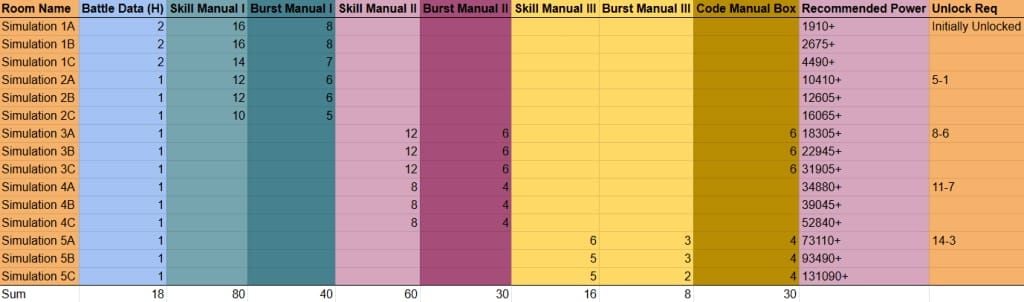
Early levels consume minimal resources:
- Level 2: 8 Skill I cumulative
- Level 3: 18 Skill I
- Level 4: 44 Skill I
- Level 5: 86 Skill I, 60 Skill II, 10 Code
- Level 6: 212 Skill I, 150 Skill II, 25 Code
- Level 7: 380 Skill I, 270 Skill II, 55 Code
Critical inflection at Level 8 (introduces Skill III):
- Level 8: 590 Skill I, 420 Skill II, 90 Skill III, 125 Code
- Level 9: 821 Skill I, 585 Skill II, 195 Skill III, 225 Code
- Level 10: 1,094 Skill I, 775 Skill II, 315 Skill III, 360 Code
Level 8-10 alone consumes 504 Skill I, 355 Skill II, 315 Skill III, 235 Code—more than double the entire Level 1-7 investment.
Diminishing Returns After Level 7
Burst Skills have identical costs with steeper Code requirements:
- Level 7: 380 Burst I, 270 Burst II, 110 Code
- Level 10: 1,094 Burst I, 775 Burst II, 315 Burst III, 720 Code
Level 7-10 upgrade: 714 Burst I, 505 Burst II, 315 Burst III, 610 Code. For supports providing team buffs, this massive investment yields 10-20% magnitude increases or 1-2 second duration extensions—rarely impacting clear success.
Performance Testing: Level 7 vs 10
Expert guides demonstrate practical application:
- Liter: Cap Burst at Level 5 for CDR/ATK utility
- Blanc: 1/1/4 → 4/4/7 → 4/4/10 (Level 7 mid-game stop)
- Noir: Damage amp at Level 7 stopping point
- Anchor: Innocent Maid: 7/10/7 final
- Helm: Aquamarine: 4/10/4 (never beyond Level 4 Burst)
Patterns repeat across meta supports—all cap Burst at/below Level 7 while prioritizing Skill 1/2.
Resource Efficiency 2026
Daily simulation farming yields:
- 80 Skill I, 40 Burst I
- 60 Skill II, 30 Burst II
- 16 Skill III, 8 Burst III
- 30 Code
Events add ~160 Skill I/80 Burst I and 120 Skill II/60 Burst II monthly. Simulation Overclock (max ratio 25): 168 Skill I, 124 Skill II, 56 Skill III, 84 Burst I, 62 Burst II, 28 Burst III.
Time calculation: 714 Burst I needed for Level 7-10. At 40 daily + 80 monthly events (2.67 daily average) = 42.67 Burst I daily. That's 16.7 days of perfect farming for one support's Level 7-10 upgrade—better allocated to multiple units reaching Level 7 or DPS hitting Level 10.
Why Supports Don't Need Level 10 Bursts
Support effectiveness stems from enabling team performance through buffs/debuffs/healing, not personal damage. This creates distinct thresholds where additional levels provide negligible benefits.
Support Role Definition
Categories include buffer/debuffers (Liter, Blanc), healers (Rapunzel), hybrid utility (Anchor). Burst Skills grant team ATK increases, cooldown reduction, defense shreds, healing. Magnitude scales with level, but functional impact plateaus earlier than DPS damage scaling.
Example: Liter's Burst at 35% ATK buff (Level 7) vs 40% (Level 10) = 5% actual damage increase to DPS units. In 3-DPS teams, that's ~1.67% overall team damage—insufficient to change outcomes while consuming resources for two additional units to Level 7.
Buff Duration vs Level
Many support Bursts increase duration with levels, but combat pacing creates natural caps. Burst rotations cycle every 20-40 seconds. If buff lasts 8 seconds (Level 7) vs 10 seconds (Level 10), the extra 2 seconds often extends beyond critical damage windows when DPS Bursts activate.
Cooldown reduction similarly reaches thresholds. Liter's CDR enables faster cycling, but gauge generation creates limits. Reducing cooldowns from 40→35 seconds (Level 7) vs 35→32 seconds (Level 10) provides diminishing returns when gauge generation is the bottleneck.
CDR Breakpoints
Specific breakpoints exist where CDR enables additional rotations in time-limited content. However, these typically occur at mid-levels (5-7), not max levels. The difference between 25% and 30% CDR rarely creates extra rotations in standard 3-minute boss encounters.
Investment guides reflect this:
- Admi: 1/1/1 → 1/1/5 (cap at Level 5)
- Biscuit: 1/1/1 → 4/4/4 → 4/4/7 (Level 7 final)
- Clay: 4/7/4 (prioritizes Skill 2 over Burst)
Real Combat Analysis
Campaign progression rarely demands max support Bursts. Players clear Chapter 25+ with Level 7 support Bursts, relying on team composition, equipment, and DPS investment. Tribe Tower similarly succeeds with Level 7 supports when DPS receive priority.
Boss Raids present the most demanding content. However, scoring depends primarily on DPS output, positioning, and burst timing—not marginal support buff increases. Top raid teams feature Level 7 support Bursts while DPS reach Level 10, confirming selective investment efficiency.
Supports Following the Level 7 Rule
Meta-defining supports demonstrate optimal patterns capping Bursts at Level 7 while prioritizing other abilities (expert guides, March 11, 2025).
Liter Investment
NIKKE's premier support provides CDR and ATK buffs. Despite critical role, recommendations cap Burst at Level 5 for functionality. Skill 1/2 receive priority for consistent uptime.
The 10/5/5 pattern reflects testing showing Level 5 Burst sufficient for all content. Players with manual shortages should prioritize Skill 1 to Level 10 before Burst beyond Level 5, and only pursue Level 7 after core DPS reach full investment.
Blanc Progression
Investment path: 1/1/4 → 4/4/7 → 4/4/10. Level 7 is the mid-game stop. Her buffs reach effectiveness at Level 7, with Level 10 classified as late-game optimization, not essential progression.
The 4/4/7 midpoint represents recommended state for most players. Only those with fully invested DPS rosters and excess manuals should pursue 4/4/10—Level 7-10 provides minimal impact vs investing in additional team members.
Noir and Meta Supports
Noir's damage amp Burst specifically gets Level 7 recommendations. Her role amplifying team damage creates similar dynamics to ATK buffers—magnitude increase from Level 7-10 translates to marginal team damage insufficient to justify cost.
- Anchor: Innocent Maid: 1/1/1 → 4/7/4 → 7/10/7 (caps Burst at 7, pushes Skill 2 to 10)
- Helm: Aquamarine: 4/10/4 (never beyond Level 4 Burst, maxes Skill 2)
Healing Units
Healing supports show even more conservative Burst patterns. Healing magnitude scales with levels, but NIKKE's design rarely requires max healing—teams either survive comfortably with moderate healing or fail due to insufficient damage/defense regardless of magnitude.
This creates scenarios where healers reach functional thresholds at Level 4-7 Burst, with additional levels providing overheal that doesn't translate to success. Test healing sufficiency at Level 7 before committing to Level 10—often lower levels prove adequate.
Exceptions: When to Upgrade Past Level 7
Specific scenarios justify higher Burst investments. Understanding exceptions prevents both over-investment in standard supports and under-investment in units requiring max scaling.
Hybrid Support-DPS Units
Units blending support and damage often need higher Bursts for damage contribution:
- 2B: 1/1/1 → 4/7/7 → 7/10/10 PVE (max Burst for utility + personal damage)
- Ade: Agent Bunny: 4/4/4 → 4/4/7 → 7/7/10 (eventual Level 10)
- Asuka Shikinami Langley: Wille: 1/1/1 → 7/4/4 → 10/7/7 (Level 7 Burst final)
These justify higher investment because Bursts contribute direct damage alongside support effects.
PvP Requirements
PvP creates different pressures than PVE. Burst damage thresholds determine survival in opening exchanges, making marginal increases potentially decisive. 2B's PVP path (1/1/1 → 4/7/7 → 4/10/10) shows Level 10 Burst prioritized over Skill 1, contrasting PVE.
However, most pure supports maintain Level 7 caps even in PVP, as their role remains enabling DPS. Evaluate compositions carefully—if support Burst magnitude directly impacts survival/kill thresholds, higher investment may prove worthwhile. Otherwise, Level 7 applies equally to PVP and PVE.
Boss Raid Optimization
Competitive scoring demands max optimization, potentially justifying Level 10 support Bursts for top-percentile performance. But this applies only to players competing for leaderboards where 1-2% damage matters.
For comfortable reward tier completion, Level 7 remains sufficient. Resources for Level 10 support Bursts could instead fund multiple DPS reaching max investment, typically yielding greater raid score improvements through team diversity and element coverage.
Future-Proofing
New content occasionally introduces mechanics favoring specific support capabilities. However, NIKKE's design maintains accessibility, rarely creating hard requirements for max skill levels. Players concerned about future-proofing should prioritize diverse rosters at Level 7 vs maximizing individual units to Level 10.
Multiple Level 7 supports across manufacturers/elements provides better future-proofing than single Level 10 units, as new content restricts by manufacturer (Tribe Tower) or favors elements (Boss Raids). Breadth over depth creates more adaptable rosters.
Skill Manual Farm 2026: Optimal Routes
Efficient farming requires understanding daily income, stamina allocation, and event prioritization. Maximize acquisition while minimizing wasted stamina.
Best Farming Sources
Simulation rooms = primary source, providing guaranteed daily yields:
- 80 Skill I, 40 Burst I
- 60 Skill II, 30 Burst II
- 16 Skill III, 8 Burst III
- 30 Code
Unlock progressively through Campaign (final tiers require Chapter 20+). Prioritize unlocking all tiers before Campaign pushing—daily income from max-tier rooms exceeds incremental Campaign benefits. Guaranteed yields provide consistent progression vs random Campaign drops.
Daily Stamina Allocation
Priority order:
- Simulation rooms (manuals, enhancement materials, credits)
- Event stages during active events (160 Skill I/80 Burst I, 120 Skill II/60 Burst II)
- Equipment farming stages
Campaign stages provide minimal manual drops vs simulation rooms—inefficient for dedicated farming. Clear Campaign for progression/first-time rewards, then redirect stamina to simulation rooms. This maximizes resource acquisition per stamina.
Auto-Battle Setup
Simulation rooms support auto-battle for passive farming. Optimize teams for clearing all waves without manual intervention.
Requirements:
- 1 healer/shielder for sustainability
- 2 DPS for clear speed
- Support units providing buffs/debuffs
Avoid overly specialized compositions struggling with specific enemy types—generalist teams ensure consistent clears across all rotations.
Event vs Story Efficiency
Events provide superior rates vs Story Mode. The 160 Skill I/80 Burst I and 120 Skill II/60 Burst II represent significant bonuses beyond daily simulation yields. Prioritize event stage clears during active events, stockpiling manuals for upcoming releases.
Simulation Overclock events offer additional income: 168 Skill I, 124 Skill II, 56 Skill III, 84 Burst I, 62 Burst II, 28 Burst III at max ratio 25. These justify stamina refreshes for accelerated progression—yields exceed standard farming efficiency.
Skill Upgrade Priority System
Systematic prioritization prevents waste on low-impact upgrades while ensuring critical skills receive timely investment.
Priority Tier 1: Essential DPS Bursts
DPS Bursts demand first priority—directly determine damage output and clear potential. Units like 2B (7/10/10 PVE), Arcana (10/10/4), Asuka (10/7/7) should reach max Bursts before investing in support Bursts beyond Level 7.
DPS Burst scaling creates multiplicative returns—higher damage enables faster clears, reducing incoming damage through shorter encounters. This defensive benefit compounds with offensive advantage, making DPS Burst investment the highest-impact allocation.
Priority Tier 2: Support Active Skills
Support Skill 1/2 often provide greater value than Bursts due to higher uptime and consistent application:
- Anchor: Innocent Maid: 7/10/7 (maxes Skill 2 before Burst)
- Ada Wong: 10/4/4 → 10/10/7 (Level 10 Skill 1/2 before Burst)
Active skills trigger multiple times per encounter, compounding value. A Skill 1 providing 10% ATK buff with 10-second uptime/15-second cooldown delivers more cumulative benefit than Burst providing 40% ATK for 8 seconds every 40 seconds. Prioritize support actives to Level 10 before Burst beyond Level 7.
Priority Tier 3: Support Bursts to Level 7
After core DPS Bursts reach Level 10 and support actives achieve Level 10 (Skill 1) and Level 5+ (Skill 2), support Bursts warrant investment to Level 7. This represents mid-game optimization, enhancing performance without excessive commitment.
Units like Blanc (4/4/7), Biscuit (4/4/7), Diesel: Treasure (1/7/4) demonstrate appropriate stops. These provide meaningful improvements over Level 4 while avoiding exponential Level 8-10 costs. Distribute Level 7 investments across multiple supports vs maximizing single units.
Priority Tier 4: Luxury Upgrades
Level 10 support Bursts, Level 10 Skill 2 on secondary units, and investments in rarely-used units constitute luxury upgrades pursued only after core roster completion. These provide marginal returns—appropriate for veterans with excess income but inefficient for mid-game progression.
Early-game players should cap SR units at Level 4 max. Manual costs for SRs exceed performance contributions, making them temporary placeholders until SSR replacements arrive. Avoid investing beyond Level 4 unless specific content demands unique capabilities.
Common Upgrade Mistakes
Resource scarcity punishes inefficient investments, creating progression bottlenecks delaying roster development by weeks/months.
Misconception: Max All Skills
New players assume all skills require Level 10 for optimal performance, leading to resource depletion on low-impact upgrades. Reality: selective investment following priority tiers yields superior results vs evenly distributed upgrades.
Focused roster with 3 DPS at 10/10/10, 3 supports at 10/5/7, 4 secondary at 4/4/4 outperforms 10 units at 7/7/7. Concentrated investment enables clearing higher-difficulty content, unlocking better rewards accelerating overall progression. Resist urge to complete every unit—strategic incompleteness optimizes efficiency.
Wasting Manuals on Unused Units
Investing in units not fitting current teams/content wastes resources. Before upgrading beyond Level 4, evaluate whether unit sees regular use in Campaign, Tribe Tower, Boss Raids, or PVP.
Units benched for multiple weeks indicate poor targets. Redirect resources to active members or stockpile for upcoming meta units. Opportunity cost of upgrading unused units—delaying critical upgrades on active units—often exceeds theoretical roster depth benefit.
Ignoring Actives While Maxing Burst
Burst Skills' dramatic visuals create psychological bias toward Burst investment, but actives often provide superior value. The 10/5/7 pattern prioritizes Skill 1 (Level 10) over Burst (Level 7) for good reason—consistent uptime beats occasional burst.
Complete Skill 1 to Level 10 before pursuing Burst beyond Level 7 on supports. DPS warrant simultaneous Skill 1/Burst investment, but even for damage dealers, Skill 1 provides consistent damage compounding over encounter duration.
Poor Stamina Management
Spending stamina on Campaign/equipment while neglecting daily simulation clears wastes the most efficient manual source. Simulation rooms reset daily—missed clears = permanently lost income.
Establish daily routines prioritizing simulation clears before other expenditures. Guaranteed yields provide predictable progression, while Campaign/equipment offer variable returns. Consistency in simulation farming creates steady upgrade cadence supporting long-term development.
Long-Term Resource Planning 2026
Strategic planning transforms random upgrades into systematic roster development, maximizing efficiency across months-long timelines.
Monthly Manual Income
Daily simulation rooms:
- 2,400 Skill I, 1,200 Burst I
- 1,800 Skill II, 900 Burst II
- 480 Skill III, 240 Burst III
- 900 Code (monthly)
Events (assuming one major monthly): +160 Skill I/80 Burst I, +120 Skill II/60 Burst II
Total monthly: ~2,560 Skill I, 1,280 Burst I, 1,920 Skill II, 960 Burst II, 480 Skill III, 240 Burst III, 900 Code. This supports 2-3 skills reaching Level 10 monthly, or 6-8 reaching Level 7.
3-Month Roadmap
Three-month horizons balance flexibility with strategic direction. Identify 3 DPS requiring Level 10 Bursts, 3 supports needing Level 7 Bursts, 6 units requiring Skill 1 to Level 10. Allocate monthly income across targets, adjusting based on content demands and new acquisitions.
Phased approach:
- Month 1: Primary DPS Bursts
- Month 2: Support Skill 1 investments
- Month 3: Secondary DPS or support Bursts to Level 7
This prevents resource fragmentation while maintaining momentum across multiple units.
Preparing for New Releases
New units create resource demands requiring advance planning. Stockpile during periods without compelling releases, building reserves for meta-defining units. Reserve of 1,000+ Skill I, 500+ Skill II, 200+ Skill III, and similar Burst quantities enables immediate investment.
For maximizing new unit potential immediately, BitTopup provides efficient buy goddess of victory nikke gems with secure transactions and excellent service, ensuring participation in limited banners without delay.
2026 meta shows continued emphasis on specialized DPS and versatile supports. Prioritize manual reserves for DPS (typically require full investment), while supports remain functional at Level 7 Burst. This ensures readiness for meta shifts without excessive hoarding.
Balancing Skills, Levels, Equipment
Skill manuals represent one dimension among character levels, equipment enhancement, and tier upgrades. Balanced progression across all dimensions outperforms hyper-specialization.
Level 200 unit with Level 4 skills and +0 equipment underperforms Level 160 with Level 7 skills and +5 equipment. Distribute proportionally—when farming manuals, simultaneously farm equipment materials. When pushing levels, maintain skill upgrade cadence. This prevents bottlenecks where one dimension limits overall performance.
Advanced Tips from Veterans
400+ day players develop optimization strategies beyond basic guides, extracting maximum efficiency from limited resources.
Long-Term Player Insights
Veterans emphasize roster breadth over individual perfection. Diverse roster with 15 units at Level 7 Burst clears more content than 5 at Level 10, as manufacturer restrictions (Tribe Tower) and element advantages (Boss Raids) demand varied compositions.
Veterans stockpile during content droughts, building reserves for new releases or meta shifts. This patience prevents reactive spending on marginal upgrades, maintaining flexibility for high-impact investments. Discipline to leave supports at Level 7 indefinitely—despite possessing sufficient manuals for Level 10—demonstrates strategic management.
Top Player Allocation
Top performers follow strict hierarchies: new meta DPS receive immediate Level 10 Burst, followed by Skill 1 to Level 10. Supports get Skill 1 to Level 10, Skill 2 to Level 5, Burst to Level 7, with no further investment until all other priorities complete.
This creates rosters with:
- 8-10 fully invested DPS (10/10/10 or 10/7/10)
- 6-8 supports at optimal investment (10/5/7)
- 10+ secondary units at minimum functional (4/4/4)
Concentrated investment in primary units enables consistent high-difficulty clears, while secondary units provide manufacturer/element coverage for restricted content.
Tribe Tower Strategy
Tribe Tower restricts teams to single manufacturers (Elysion, Missilis, Tetra, Pilgrim), demanding investment across multiple rosters. However, Level 7 support Burst rule applies equally—each manufacturer needs 2-3 DPS with Level 10 Bursts and 2-3 supports with Level 7 Bursts.
Identify core DPS per manufacturer first:
- Elysion: Scarlet, Modernia
- Missilis: Laplace, Guilty
- Tetra: Tove, Naga
- Pilgrim: Modernia: Goddess, Dorothy
After manufacturer DPS reach full investment, supports receive Level 7 Burst upgrades.
Competitive PvP Optimization
PvP meta shifts rapidly with new releases and balance changes, making conservative support investments even more critical. Resources saved by capping support Bursts at Level 7 enable faster meta adaptation, funding new PvP-focused investments.
PvP-specific units like 2B warrant adjusted investment (4/10/10 PVP vs 7/10/10 PVE), but most supports maintain Level 7 caps. Burst damage and survival thresholds in PvP favor DPS investment over marginal support buff increases, reinforcing Level 7 rule's applicability across modes.
FAQ
What's the difference between Burst and regular skills in NIKKE?
Units feature Skill 1 (first active, auto-activation), Skill 2 (second active, longer cooldown), and Burst Skill (ultimate requiring Burst gauge). Bursts provide most powerful effects but activate less frequently, while Skill 1/2 trigger automatically. Investment priorities differ—DPS need max Burst damage; supports prioritize Skill 1 uptime over Burst magnitude.
How many manuals for Level 7 to 10 upgrade?
714 additional Skill I (1,094 total minus 380 at Level 7), 505 Skill II (775 minus 270), 315 Skill III (introduced Level 8), 305 Code (360 minus 55). Burst Skills identical: 714 Burst I, 505 Burst II, 315 Burst III, 610 Code (720 minus 110). This represents more than double entire Level 1-7 investment for marginal support gains.
Which supports benefit most from Level 7 Burst cap?
Pure supports providing team buffs/debuffs/healing reach effectiveness at Level 7. Liter (CDR/ATK), Blanc (team buffer), Noir (damage amp), Anchor: Innocent Maid (hybrid), Helm: Aquamarine all follow patterns capping Burst at/below Level 7. These generate value through enabling DPS, not personal damage—making Level 7-10 upgrade's marginal buff increases insufficient to justify costs.
Where to farm manuals efficiently in 2026?
Simulation rooms most efficient: 80 Skill I, 40 Burst I, 60 Skill II, 30 Burst II, 16 Skill III, 8 Burst III, 30 Code daily at max tier. Events add 160 Skill I/80 Burst I and 120 Skill II/60 Burst II periodically. Simulation Overclock: 168 Skill I, 124 Skill II, 56 Skill III, 84 Burst I, 62 Burst II, 28 Burst III at max rewards. Prioritize daily simulation clears before Campaign/equipment for consistent income.
Should I max Liter's Burst or stop at Level 7?
Liter's guides recommend capping Burst at Level 5 for CDR/ATK functionality, with Level 7 representing luxury optimization. Her Skill 1/2 provide greater value through consistent uptime, warranting Level 10 and Level 5 respectively before considering Burst upgrades. Resources for Level 7-10 Burst (714 Burst I, 505 Burst II, 315 Burst III, 610 Code) could instead fund multiple DPS reaching full investment, yielding superior team performance.
What skills should I prioritize in 2026?
Priority hierarchy: (1) DPS Bursts to Level 10 for max damage, (2) Support Skill 1 to Level 10 for consistent uptime, (3) DPS Skill 1 to Level 10 for sustained damage, (4) Support Skill 2 to Level 5 for cost-efficient utility, (5) Support Bursts to Level 7 for adequate buff magnitude, (6) DPS Skill 2 to Level 7-10 based on scaling. Avoid upgrading SR units beyond Level 4 or investing in unused units regardless of rarity.