What Makes Pilgrims Special
Pilgrims dominate endgame content through exceptional kits and stats. Modernia and Red Hood define meta compositions for Tribe Tower and high-difficulty campaigns. Their exclusivity correlates directly with power—the acquisition barrier gates the game's strongest units.
In competitive modes, multiple Pilgrims unlock significantly higher damage ceilings and survivability. This performance gap incentivizes dedicated farming toward Pilgrim acquisition over diversifying standard SSR rosters.
How Pilgrim Molds Function
September 24's optimization introduced three mold types: High-Quality Access Records, Perfect Molds, and Manufacturer's Perfect Molds. These replaced orange molds in Black Market, with old molds converting to body labels at 6,000 labels per extra SSR duplicate.
Manufacturer's Perfect Molds guarantee SSRs but maintain Pilgrim exclusions. New molds were retroactively awarded based on Tribe Tower progress and now appear as ongoing tower rewards, creating sustainable acquisition pipelines.
Data-Driven Farming Strategies
Community data shows significant variance between theoretical rates and practical timelines. One documented case pulled SSR Pilgrim Scarlet within 10 attempts—a statistical outlier demonstrating extreme RNG variance at 0.0833% base rate.
Energy efficiency calculations are critical when standard rates offer minimal Pilgrim chances. Players must evaluate whether direct pulling, mold accumulation through Tribe Tower, or targeted event spending provides optimal resource-to-Pilgrim conversion.
Doro Community Data Collection: Methodology & Reliability
Community-driven data aggregates player-reported results across thousands of pulls, creating sample sizes large enough to identify meaningful patterns in drop rates and stage variations.
What is Doro
Doro is a collaborative player initiative tracking drop rates across all NIKKE content. Participants submit pull results, stage rewards, and mold data through standardized formats. This crowdsourced approach compensates for limited official transparency beyond the disclosed 0.0833% rate.
Methodology relies on volume—individual experiences vary wildly, but aggregated data from hundreds of participants reveals statistical trends. December 2025 data reflects post-September optimization performance.
December 2025 Sample Size
Current datasets include mid-to-endgame players who've cleared sufficient campaign content. The participant base skews toward dedicated players with consistent daily energy expenditure.
Sample sizes vary considerably. High-traffic chapters show thousands of recorded runs, while newer stages have limited reporting. Well-documented stages provide reliable guidance; sparse data requires caution.
Statistical Validity
The 0.0833% rate translates to roughly 1 in 1,200 pulls. Individual players experience extreme variance—some get Pilgrims within hundreds of pulls, others need several thousand. Community data smooths fluctuations to reveal underlying rates.
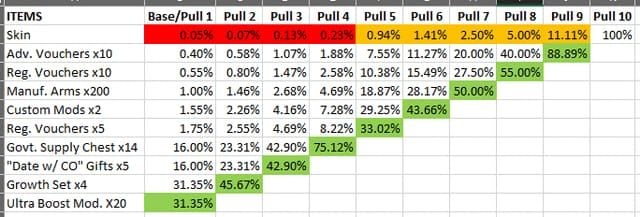
At 0.0833% per pull, probability of obtaining at least one Pilgrim within 1,200 pulls reaches ~63%—meaning 37% of players attempting 1,200 pulls receive zero Pilgrims.
Community vs Official Data
Official disclosure confirms 0.0833% Pilgrim rate on standard banners and Pilgrim exclusion from guaranteed SSR mechanics. Community data validates these figures while providing granularity about practical timelines and resource efficiency.
Paid banners officially guarantee one SSR excluding Pilgrims, Helm, and Laplace. This exclusion appears consistently across banner types, confirming Pilgrim acquisition requires exceptional luck or limited-time Pilgrim events like the October 3rd anniversary rerun.
December 2025 Pilgrim Mold Drop Rate Analysis
The current mold ecosystem operates on clear exclusion principles. Standard mold guarantees explicitly remove Pilgrims, creating a two-tier system where Pilgrims require dedicated pursuit.
Overall Drop Statistics
Campaign stages don't directly drop Pilgrim Molds. Pilgrim acquisition relies on accumulating gacha currency and mold resources convertible to pull attempts. The 0.0833% rate applies uniformly across standard banner pulls regardless of currency source.
For maximizing pulling capacity, buy goddess of victory nikke gems through BitTopup for reliable premium currency access with secure transactions.
Energy-to-pull conversion efficiency varies by stage rewards and clear efficiency. Higher-difficulty stages offer better resource-per-energy ratios when cleared consistently without excessive retries.
Campaign Chapter Breakdown
The new mold system integrates primarily through Tribe Tower rewards. Players advancing through towers receive High-Quality Access Records, Perfect Molds, and Manufacturer's Perfect Molds as progression rewards. This creates structured acquisition tied to account advancement.

Campaign stages contribute indirectly by providing resources convertible to pulls—gems, tickets, materials. December 2025 optimization ensures Tribe Tower progression yields consistent mold acquisition.
Hard Mode vs Normal Mode
Hard mode offers superior resource efficiency per energy, providing higher gem yields and better material drops. However, Pilgrim acquisition remains unchanged—neither mode increases 0.0833% rates or provides Pilgrim-specific molds.

Hard mode's advantage is faster resource accumulation. Players farming hard mode generate pull currency quicker, enabling more frequent attempts within the same timeframe. This increases total attempts over time without changing individual pull probability.
Stage-Specific Rankings
Resource efficiency rankings prioritize stages offering maximum gems and tickets per energy. Later chapters generally provide better ratios, but accessibility requires strong teams many mid-game players lack.
Tribe Tower remains the most reliable mold source. September 24's addition of new molds as ongoing rewards creates predictable acquisition tied to tower advancement. Prioritize tower progression for consistent SSR mold accumulation.
Energy Efficiency Calculations
Energy management directly impacts long-term Pilgrim timelines. With Pilgrims excluded from guaranteed systems, players must maximize total pull volume to overcome 0.0833% probability through sheer attempt quantity.
Average Energy Cost Per Mold
The 50-pull guarantee for New Commander Special Molds provides baseline efficiency. Players accumulating 50 mold pulls receive one guaranteed SSR—though not a Pilgrim. This establishes a resource floor for SSR acquisition that doesn't apply to Pilgrim hunting.
Converting energy to pulls requires intermediate steps: energy generates stage rewards, rewards convert to gems/tickets, currency funds attempts. Each layer introduces efficiency variance based on stage selection and clear performance.
Best Conversion Stages
Tribe Tower advancement provides the most direct energy-to-mold conversion through progression rewards. Unlike campaign stages requiring repeated clears for incremental gains, tower advancement offers one-time mold rewards for achieving new floors.
Campaign farming remains necessary for daily resource generation between tower milestones. Later hard mode stages offer optimal gem-per-energy ratios, but players must balance efficiency against team capability.
Daily Energy Allocation for F2P
F2P players receive limited daily energy, making allocation critical. Optimal strategy dedicates energy to highest-yield content accessible with current team strength—hard mode campaign stages at the edge of clear capability.
Tower attempts should consume available daily entries regardless of energy cost. One-time mold rewards for floor advancement exceed equivalent energy spent on repeatable campaign content.
When to Use Energy Recharge
Energy recharge items offer best value during limited-time events with enhanced drops or special rewards. Standard campaign farming rarely justifies recharge consumption.
Exception: Pilgrim-specific banner events like October 3rd anniversary rerun. These limited windows provide actual Pilgrim acquisition opportunities beyond 0.0833% rates. Aggressive energy expenditure including recharges maximizes chances during brief availability.
RNG Variance and What Numbers Mean
The 0.0833% rate creates extreme outcome variance. This translates to roughly 1 Pilgrim per 1,200 pulls under expected value, but individual experiences deviate wildly. Understanding variance sets realistic expectations.
Probability Distributions
At 0.0833% per pull, probability of at least one Pilgrim within 1,200 pulls reaches ~63%—meaning 37% attempting 1,200 pulls receive zero Pilgrims. Low-probability events cluster unpredictably rather than distributing evenly.
The documented Scarlet pull within 10 attempts represents ~0.083% probability—a 1-in-1,200 occurrence inevitable given sufficient community size. Such outliers don't indicate hidden rate increases; they're statistical inevitabilities.
Why Personal Experience Differs
Individual players represent single data points within broader probability distribution. One player might get three Pilgrims in 500 pulls while another gets zero in 3,000—both fall within expected variance for 0.0833% rates.
Human pattern recognition creates false correlations. Players attribute Pilgrim pulls to specific times, stages, or rituals when outcomes result purely from RNG. December 2025 data shows no evidence of time-based variations or stage-specific bonuses.
Luck Streaks vs Regression
Luck streaks—multiple Pilgrims in short timeframes—occur randomly within large samples. These don't predict future results. Similarly, extended dry spells don't create due outcomes. Each pull maintains independent 0.0833% probability.
Statistical regression means extreme outcomes trend toward average over time. Exceptional early luck will likely normalize with continued pulling. Unlucky early experiences don't guarantee future compensation—the system has no memory.
Setting Realistic Expectations
Approach Pilgrim hunting with long-term perspectives. Daily farming generates incremental pull currency accumulating toward eventual attempts. Expecting Pilgrim acquisition within specific timeframes creates disappointment—0.0833% means many players experience extended periods without Pilgrim pulls.
Treat Pilgrim pulls as exceptional bonuses rather than expected outcomes. Focus primary progression on guaranteed systems while accumulating standard banner attempts as secondary Pilgrim opportunities.
Common Misconceptions
Misinformation about Pilgrim acquisition spreads through community channels. Clarifying misconceptions helps players make informed resource decisions.
'Guaranteed Drop' Myth
No guaranteed Pilgrim acquisition exists outside limited-time special banners. The 50-pull New Commander Special Mold guarantee explicitly excludes Pilgrims, as do paid banner guarantees. Players can't farm Pilgrims through deterministic processes—all standard acquisition relies on 0.0833% rates.
Pilgrim Supply Set Voucher costs 600 and provides 1 attempt, but operates under standard rates rather than offering guaranteed outcomes.
Stage First Clear Effects
Stage first-clear rewards provide one-time resource bonuses but don't influence gacha rates. The 0.0833% rate applies uniformly to all standard banner pulls regardless of currency source.
Campaign progression unlocks higher-yield farming stages but doesn't create Pilgrim-specific drop opportunities. Progression value lies in improved resource generation efficiency.
Time-of-Day Superstitions
No evidence supports time-based rate variations in December 2025 data. The 0.0833% rate operates continuously without daily fluctuations outside explicitly announced events. Claims of better results at specific times reflect confirmation bias.
Server reset affects daily missions and energy regeneration but doesn't influence gacha probabilities.
Pity System Confusion
NIKKE's pity guarantees SSRs at specific thresholds but maintains Pilgrim exclusions. The 50-pull guarantee provides an SSR excluding Pilgrims, Helm, and Laplace. This creates safety net for general SSR acquisition while leaving Pilgrim hunting entirely RNG-dependent.
Players sometimes confuse SSR pity with Pilgrim acquisition, expecting guaranteed Pilgrims after extended pulling. The system functions as designed—Pilgrims remain outside guaranteed mechanics by deliberate design.
Optimal Farming Routes
Resource optimization requires stage selection aligned with current progression. Optimal farming balances energy efficiency with clear reliability.
Beginner Path (Chapters 1-10)
Early-game players should prioritize campaign progression over farming optimization. Story advancement unlocks essential systems and provides substantial one-time gem rewards exceeding optimized stage farming value.
Once progression stalls, farm the highest hard mode stage clearable reliably. Early hard mode offers modest efficiency but remains accessible. Priority is establishing consistent daily resource generation.
Mid-Game Strategy (Chapters 11-20)
Mid-game players access significantly improved hard mode efficiency. Chapters 11-20 hard mode provide better gem ratios while remaining clearable with properly invested teams. Identify highest reliable clear stage and establish as primary daily farming target.
Tribe Tower becomes increasingly important. Mold rewards for tower advancement provide guaranteed SSR opportunities complementing campaign farming. Attempt tower progression during power spikes when new investments enable floor advancement.
Endgame Routes (Chapter 21+)
Late-campaign hard mode offers peak resource efficiency but requires fully developed teams. Farm the highest stage auto-clearable reliably, minimizing time investment while maximizing resource generation.
Maintain aggressive Tribe Tower progression. Retroactive mold awards based on tower progress reward veteran advancement, and ongoing rewards provide sustainable SSR mold acquisition.
Event Stage Considerations
Limited-time events occasionally offer enhanced resource generation or special acquisition opportunities. The October 3rd anniversary Pilgrim rerun exemplifies high-value temporary content where aggressive resource expenditure makes strategic sense.
Accumulate pull currency during standard periods and deploy reserves during Pilgrim-specific events. These limited windows provide actual rate improvements or focused pools dramatically increasing acquisition probability versus standard 0.0833%.
Historical Drop Rate Trends
September 24 optimization introduced the new mold system, replacing orange molds with High-Quality Access Records, Perfect Molds, and Manufacturer's Perfect Molds. This represented structural change to SSR acquisition while maintaining Pilgrim exclusions.
Major Update Impact
December 8th update established cutoff for mold guarantee eligibility, excluding newer characters from 50-pull guarantee. This creates moving exclusion window where recent additions join Pilgrims outside guaranteed mechanics.
Retroactive mold awards based on Tribe Tower progress provided veterans with accumulated resources reflecting historical advancement. This one-time compensation ensured existing players weren't disadvantaged by system transition.
Developer Adjustments
Addition of new molds to Tribe Tower rewards as ongoing drops responded to community requests for more deterministic SSR acquisition. While Pilgrims remain excluded, improved mold availability helps build supporting rosters reliably.
Black Market integration of new molds and body label exchange for old molds created resource conversion paths preserving player investments during transition.
Future Predictions
The pattern of limited-time Pilgrim events like 3rd anniversary rerun suggests periodic special acquisition opportunities will continue. Anticipate quarterly or semi-annual Pilgrim-focused events providing temporary rate improvements or focused pools.
Mold system will likely expand with additional sources while maintaining Pilgrim exclusions. Fundamental design treats Pilgrims as premium acquisitions outside standard progression—unlikely to change given its role in monetization and retention.
Tracking Personal Drop Rates
Personal tracking provides accountability and identifies when individual results deviate significantly from expected rates. While single-player data lacks statistical significance, tracking creates awareness of actual resource expenditure and timelines.
Manual Tracking Setup
Record pull dates, currency sources, and results for each attempt. Spreadsheet columns: pull number, date, currency type, result rarity, specific character obtained. Granular data enables analysis versus community averages.
Track total pulls separately from Pilgrim-specific results. The 0.0833% rate means most players accumulate hundreds or thousands of pulls between Pilgrim acquisitions.
Key Metrics
Primary metrics: total pulls attempted, total Pilgrims obtained, pulls-per-Pilgrim ratio. Calculate personal Pilgrim rate by dividing Pilgrims obtained by total pulls, then compare against 0.0833% baseline.
Secondary metrics track resource generation: daily energy expenditure, gems earned per day, pulls completed per week. These identify optimization opportunities independent of gacha variance.
When to Adjust Strategy
Adjust strategy based on capability changes, not RNG outcomes. Unlocking characters enabling harder content justifies shifting to higher-efficiency stages. Poor gacha luck doesn't indicate farming problems—0.0833% ensures extended dry periods occur regularly.
Reassess farming routes after major milestones: clearing new chapters, achieving tower floors, obtaining meta-defining characters.
Community Resources
Community data aggregation benefits from broad participation. Contributing tracking data improves overall sample sizes and statistical reliability. Shared data helps identify potential rate changes or system issues individual tracking can't detect.
Resource Management Beyond Farming
Pilgrim acquisition represents one component of broader progression. Effective resource management balances Pilgrim hunting against other essential investments.
Balancing with Other Needs
Core Dust and Skill Books require substantial investment. Allocate resources between acquiring new characters through pulls and developing existing roster through upgrades. Overinvesting in pulls while neglecting development creates shallow rosters of underleveled characters.
Optimal balance dedicates sufficient resources to maintain progression in current content while accumulating pull currency for future opportunities.
Which Pilgrim to Prioritize
When Pilgrim opportunities arise through special events, prioritize based on account needs. Red Hood and Modernia provide exceptional DPS for players lacking strong damage. Dorothy offers unique utility for specific content. Newer players benefit from versatile Pilgrims performing across multiple modes.
Body label system awards 6,000 labels per extra SSR duplicate, creating long-term resource accumulation. Consider duplicate value when evaluating pull decisions.
Upgrade Material Timing
Upgrade materials should flow to characters seeing active use. Investing heavily in newly acquired Pilgrims before accumulating support resources creates temporary power spikes followed by progression stalls when reserves deplete.
Maintain reserve of upgrade materials for immediate investment when acquiring high-priority characters while ensuring primary team receives consistent development.
Long-Term Planning
Multi-month planning helps navigate 0.0833% rates. Set realistic acquisition timelines based on expected pull volume. Players generating 100 pulls monthly should anticipate roughly one Pilgrim per year from standard attempts.
Special events and anniversaries provide concentrated acquisition opportunities justifying resource accumulation. Maintain pull currency reserves for deployment during limited-time Pilgrim events rather than spending continuously on standard banners.
Smart Gem Management
While farming provides F2P progression, strategic gem purchases accelerate timelines for players willing to invest. Understanding when paid resources provide optimal value minimizes expenditure while maximizing results.
When Direct Purchase Makes Sense
Direct gem purchases offer best value during limited-time Pilgrim events with improved rates or focused pools. October 3rd anniversary Pilgrim rerun exemplifies high-value spending where purchased gems convert to attempts with significantly better probability than standard 0.0833%.
Standard banner pulling rarely justifies gem purchases given minimal Pilgrim rate. Reserve paid resources for special events, guaranteed systems, or time-sensitive opportunities where gem-to-value conversion exceeds free farming.
Maximizing Paid Resource Value
Pilgrim Supply Set Voucher costs 600 and provides 1 attempt, establishing baseline cost-per-pull. Evaluate all paid options against this benchmark, prioritizing purchases offering better gem-to-pull ratios or bonus materials.
Paid banner guarantees explicitly exclude Pilgrims, making them poor value for Pilgrim hunting despite guaranteeing SSRs. Avoid paid guarantees and instead accumulate gems for high-volume pulling during Pilgrim events.
BitTopup: Secure Gem Top-Up
BitTopup provides reliable gem top-up with competitive pricing and fast delivery. The platform offers secure transactions with excellent customer service, supporting NIKKE commanders seeking efficient resource acquisition. High user ratings and wide game coverage make BitTopup trusted for players accelerating Pilgrim collection through strategic purchases.
Combine BitTopup's efficient delivery with smart spending timing—purchasing during Pilgrim events maximizes every gem's value. 24/7 support ensures reliable access when limited-time opportunities arise.
FAQ
What are Pilgrim Molds in NIKKE?
Pilgrim Molds don't exist as discrete items. Pilgrims are acquired through standard gacha at 0.0833% rates or special limited events. The mold system guarantees SSRs but explicitly excludes all Pilgrims.
How accurate is Doro community data?
Community data validates the official 0.0833% rate through aggregated reports. While individual experiences vary, large sample sizes reveal patterns consistent with disclosed rates, reflecting current system performance.
Which stages have highest Pilgrim Mold drop rates?
No campaign stages drop Pilgrim-specific molds or offer increased rates. The 0.0833% applies uniformly to all standard pulls. Tribe Tower provides most reliable mold acquisition through progression rewards, though these exclude Pilgrims.
Is hard mode better for farming Pilgrim Molds?
Hard mode offers superior resource-per-energy efficiency, generating more gems/tickets for funding attempts. It doesn't increase Pilgrim rates—advantage lies in faster pull currency accumulation.
How much energy for one Pilgrim Mold?
Pilgrim acquisition requires accumulating pull currency through energy expenditure, then attempting pulls at 0.0833%. Expected value suggests ~1,200 pulls per Pilgrim, but individual results vary dramatically. Energy-to-Pilgrim conversion depends on farming efficiency and RNG.
Has Pilgrim Mold drop rate changed recently?
September 24 optimization introduced new mold types but maintained Pilgrim exclusions. The 0.0833% standard rate remains unchanged. December 8th update established character eligibility cutoffs but didn't alter Pilgrim mechanics.
Ready to accelerate your Pilgrim collection? Get gems for guaranteed pulls through BitTopup's secure platform. Fast delivery, competitive rates, and 24/7 support for NIKKE commanders. Top up now and bring your target Pilgrim home faster!