Physics Engine Breakdown
The collision system calculates surface adhesion based on contact angle, velocity, and gravity modifiers. When approaching walls at specific angles while inputting directional commands within 0.3-second windows, the engine temporarily registers characters as grounded despite vertical orientation.
Negative gravity ladders—placed intentionally or generated through overlapping physics volumes—create zones where standard gravity rules don't apply. A -1.5x gravity volume enables sustained vertical positioning that fails under normal -9.8 m/s² acceleration.
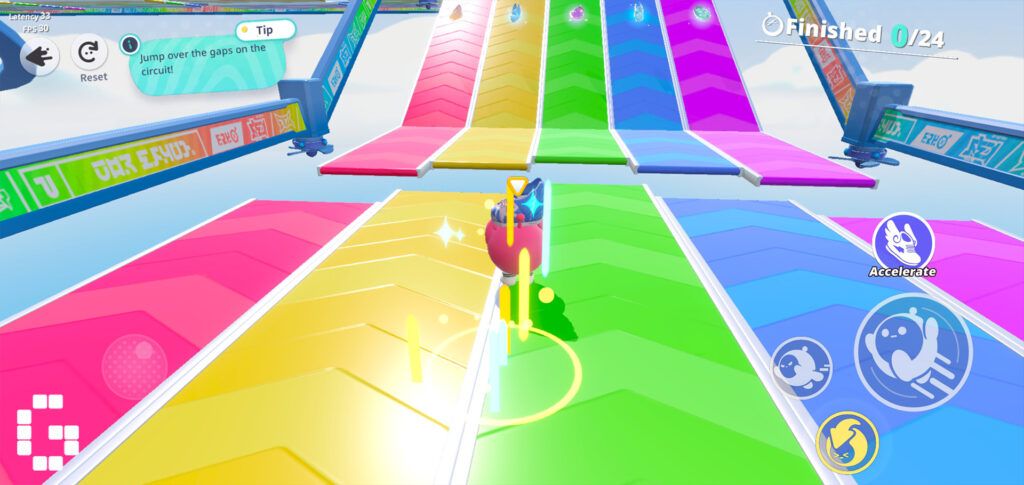
Waterfall Wall Climb demonstrates this: alternating 1-second upward inputs with 0.5-second neutral pauses counters the 2-second downward force cycle, saving 5-6 seconds vs intended routes. Gigantify power-up reduces climb time by 40%, though its 16-second cooldown at Level 14 requires strategic timing.
Intended Mechanics vs Glitch Exploitation
Standard wall interactions limit vertical movement to surfaces tagged climbable in the map editor. These feature visible handholds and trigger climbing animations automatically. The glitch bypasses restrictions by forcing collision states on unmarked surfaces.
Intended mechanics enforce stamina-like limitations through timed inputs—hold too long and you slide. The glitch circumvents this via frame-perfect sequences that reset the slide timer. On 45-degree icy floors doubling slide speed, this creates impossible acceleration.
Map creators sometimes design glitch-friendly zones by placing elevator undersides with 5-meter trigger ranges initiating 3-second ascents. These blur the line between exploit and feature.
Prerequisites
Before attempting vertical wall standing, master basic movement techniques. Mid-air charge jumps extend horizontal distance by 30%—foundational for transitioning from wall stands to forward momentum. Dinosaur Statue Leap eliminates 15 meters of pathing, requiring 90% gauge release for optimal distance.
Compatible walls: waterfall surfaces, negative gravity volumes, wooden structures in jungle maps. Vine Swing Bypass features three wooden crates 2 meters left of first vine anchor, with target ledge 4 meters above standard path. Not all vertical surfaces work—smooth metal and glass lack necessary collision properties.
Camera optimization proves critical. 60-degree upward angle from platform edges provides visual reference for Canopy Drop Skip's 0.5-meter landing zone. Default settings cause 1-2 meter misjudgments, costing 6-7 seconds recovery.
Control Requirements
Mobile: Position left thumb over directional joystick's upper-right quadrant for simultaneous forward/upward inputs. Enable fixed joystick to prevent drift. Use thumb edge for jump presses—provides better tactile feedback. Enable simplified controls for charge jumps to auto-release at 100%.
PC: Rebind jump to Space, add secondary binding to mouse side button if available. Set mouse to 500 DPI with 1.2 in-game multiplier. Practice 1-second hold, 0.5-second release rhythm with 120 BPM metronome.
Controller: Map jump to A/X, charge to right trigger, directional to left stick. Adjust stick deadzone to 8-12%. Enable toggle crouch for Underground Tunnel's continuous rolling. Increase trigger sensitivity to 90% for 90% gauge releases at 81% physical depression.
Identifying Compatible Walls

Waterfall surfaces: Most reliable, identifiable by animated water textures and rushing sounds. Apply downward force every 2 seconds but accept alternating input pattern. Standard 3x8-meter waterfall appears in ~40% of jungle maps.
Negative gravity volumes: Lack visual indicators—require experimental jumping. Fall speed noticeably decreases or reverses. Canopy Drop Skip's -1.5x volume sits above wooden beam—look up 60 degrees from platform's right edge.
Wooden crate clusters: Staggered vertical formations support wall standing through collision stacking. Vine Swing Bypass's three-crate configuration creates overlapping hitboxes registering as continuous surfaces.
Step-by-Step Execution
Phase 1: Approach (0-2 Seconds)
Sprint toward target wall until 1.5 meters distance. For Vine Swing Bypass, sprint to left edge without jumping, maintaining ground contact until final input.
Adjust camera to 60 degrees upward for vertical walls or 45 degrees for angled surfaces. This aligns collision box with wall's surface normal vector, maximizing contact area. Incorrect angles cause immediate failure.
Face wall perpendicular for 90-degree surfaces, or 45-degree angles for corners. Canopy Drop Skip requires alignment with platform's right edge—deviations over 0.3 meters miss the 0.5-meter landing zone.
Phase 2: Jump Timing (Frame-Perfect)

Initiate jump while holding forward. At apex (~0.4 seconds after leaving ground), begin alternating 1-second upward inputs with 0.5-second neutral pauses. This counters Waterfall's 2-second downward cycle.
For charge jumps like Dinosaur Statue Leap, hold charge until 90% capacity before releasing. Earlier reduces distance 15-20%; at 100% adds unpredictable vertical momentum. Mid-air charge jump extends horizontal distance 30% vs standard jumps.
On negative gravity surfaces, reduce to 0.8-second upward holds with 0.4-second pauses. Altered gravity reduces force you're countering. Canopy Drop Skip's -1.5x zone requires 1.5-second charge after stepping off beam.
Phase 3: Stabilization
Once collision registers (animation shifts from falling to static), reduce directional input to 50%. Full-strength inputs trigger slide mechanic. Maintain alternating rhythm with gentler pressure.
Monitor vertical position. On Waterfall's 8-meter surface, reach 4-meter midpoint within 5 seconds (3 with Gigantify). Slower progress indicates timing drift—reset by releasing all inputs 0.2 seconds, then resume.
For stands exceeding 10 seconds, incorporate 5-degree camera adjustments every 3-4 seconds. Collision system recalculates based on current orientation; static angles accumulate errors causing detachment.
Phase 4: Transition
Exit via charged jump at 70-80% capacity while inputting horizontal direction. Generates momentum to clear wall's collision boundary. Underground Tunnel's exit requires this to preserve 2-second velocity boost.
For higher platforms, combine exit jump with immediate directional input toward target. Vine Swing Bypass's second jump must occur within 0.3 seconds of landing—missing costs 6-7 seconds.
When chaining multiple stands, reduce exit charge to 50-60% to minimize airtime. Underground Tunnel's three 90-degree turns demand this, as excessive air breaks continuous rolling generating 25% velocity above caps.
Troubleshooting
Sliding Issues

Sliding occurs when neutral pause exceeds 0.7 seconds between upward inputs on standard gravity. Game interprets extended pauses as intentional descent. On waterfalls, pauses over 0.6 seconds allow two force applications before next counter-input.
Gigantify's 40% time reduction shortens safe pause to 0.4 seconds—counterintuitive drawback. Players must recalibrate from 0.5-second pauses or accept faster climbing with increased slide risk.
Input overlap—holding upward before releasing previous input—creates conflicting calculations defaulting to slide. Ensure complete release for full 0.5-second neutral duration.
Camera Errors
Angles below 45 degrees reduce adhesion surface area 60-70%. Canopy Drop Skip's 60-degree requirement exists because shallower angles redirect momentum horizontally, missing -1.5x gravity volume boundaries.
Angles above 75 degrees cause bouncing—upward velocity becomes too dominant. Manifests as repeated micro-jumps, each resetting position downward 0.3-0.5 meters.
Dynamic drift accumulates from mouse/stick imprecision. Every 3-4 seconds, collision recalculates based on current orientation. 10-degree drift over 12 seconds crosses adhesion threshold, triggering detachment. Counter with deliberate 5-degree corrections every 3 seconds.
Input Overlap
Overlapping directional inputs with jump during initial collision prioritizes jump momentum over adhesion. Separate by minimum 0.1-second gaps—press jump, wait for apex, then begin directional holds.
Vine Swing Bypass's 0.3-second window tempts buffering jump before landing. Creates overlap with landing collision, causing jump to register as ground bounce, reducing height 40% and missing 4-meter ledge.
Charge overlap occurs maintaining charge while inputting directional changes. Dinosaur Statue Leap requires releasing at 90%, then immediately inputting forward—not simultaneously. Simultaneous inputs reduce horizontal distance 15-20%.
Advanced Techniques
Corner Standing
Exploits collision stacking where perpendicular walls meet, doubling adhesion strength. Approach at 45-degree angles bisecting wall faces so collision box contacts both simultaneously. Allows sustained standing without alternating inputs.
Increased adhesion enables charge jump preparation while mounted. Establish stable contact, hold charge to 80%, release with directional input. Generates momentum for Dinosaur Statue Leap's 15-meter elimination from vertical surface.
Use corners as reset points when chaining walls. Route through corners every 10-12 meters to recalibrate timing and camera without losing vertical progress.
Momentum Preservation
Entering wall stands with existing velocity preserves 60% if inputs occur within 0.4 seconds of contact. Geysers provide 15-meter boosts after 2-second delays; timing wall contact immediately after carries residual upward velocity, reducing input duration 30%.
45-degree icy floors doubling slide speed create horizontal momentum for wall approaches. Build speed, execute 90-degree turn toward wall at max velocity. Contact within 0.5 seconds of leaving ice to preserve doubled speed as horizontal-to-vertical conversion, launching 3-4 meters up instantly.
Momentum decay: 60% after 0.4s, 35% after 0.8s, below 10% after 1.2s. Chain techniques within these windows for compounding advantages. Underground Tunnel's 2-second post-exit boost enables chaining into subsequent obstacles.
Chaining Sequences
Multi-wall sequences require exit trajectory planning for optimal entry angles. Transitioning from Wall A to Wall B 5 meters away: execute Phase 4 exit at 75% charge with camera oriented 30 degrees toward Wall B's contact point.
Vine Swing Bypass into Canopy Drop Skip chain: complete Bypass's 4-meter ascent, execute 0.3-second second jump toward beam, land with forward momentum, immediately transition into Drop Skip's 60-degree positioning. Total: 8-9 seconds, saving 7-9 seconds vs standard routing.
Maintain rhythm across chains despite changing wall properties. Establish base rhythm on first wall (1-second/0.5-second Waterfall pattern), adjust ±0.2 seconds for subsequent walls. Negative gravity needs slower rhythms; standard walls need faster.
Practical Applications
Identifying High-Value Spots
High-value spots combine significant savings (3+ seconds) with reasonable success (50%+ after practice). Vine Swing Bypass: 4-5 second savings, 60% success once mastering 0.3-second timing. Contrast Dinosaur Statue Leap's 40% success—valuable for records but inconsistent for reliable completions.
Visual markers: wooden crate clusters suggest collision stacking, waterfall textures confirm compatible surfaces, unusually positioned platforms mark negative gravity boundaries. Canopy Drop Skip's beam sits conspicuously 8 meters above standard path—intentional design signaling advanced routing.
Map completion distributions reveal glitch adoption. If top 20% cluster 8-12 seconds faster than median, major skips exist. Study these runs to identify bypassed obstacles, reverse-engineer techniques.
Route Optimization
Prioritize glitches where time savings exceed execution duration plus failure recovery. Waterfall saves 5-6 seconds but requires 8-10 seconds—only worthwhile bypassing 15+ second obstacles. Calculate: (standard time) - (glitch time + failure rate × recovery).
Underground Tunnel: 6-7 second savings, 4-5 second execution, 80% success, 3-second recovery. Net: 6.5 - (4.5 + 0.2 × 3) = 1.4 seconds average. Three such opportunities compound to 4-5 second total advantage.
Power-up timing maximizes effectiveness. Gigantify's 16-second cooldown activates before Waterfall attempts for 40% reduction. Rewind's 35-second cooldown at Level 20 insures low-success techniques like Dinosaur Statue Leap, enabling aggressive attempts without recovery penalties. For premium items, buy eggy coins cheap from BitTopup with instant delivery.
Strategic Bypassing
Assess difficulty weighing consistency vs time investment. 20-second section with 95% success often faster than 12-second glitch with 60% success when accounting retries. Calculate expected time: (route time) / (success rate).
Canopy Drop Skip's 3-4 second savings become 4.3-5.7 seconds expected (3.5 / 0.7 = 5s). Standard route: 8 seconds at 95% (8.4s expected). Skip saves 3.1-3.4 seconds average—worthwhile competitively but marginal casually.
Checkpoint positioning influences risk tolerance. Attempt high-risk skips immediately after checkpoints to minimize retry penalties. Reserve high-consistency techniques for long checkpoint-free sections risking 30+ seconds progress loss.
Map Creator Perspectives
Understanding creator intent separates respectful usage from exploit abuse. Many intentionally place negative gravity volumes and collision-stacking as skill-based shortcuts. Elevator undersides with 5-meter trigger ranges exemplify designed elements requiring glitch knowledge.
Intentional Design
Intentional integration appears through deliberate object placement serving no aesthetic purpose. Three crates 2 meters left of vine anchor—Vine Swing Bypass configuration—creates collision stacking too precise for accident. Creators expect advanced players to discover and utilize.
Negative gravity in accessible locations signals intentional shortcuts. Canopy Drop Skip's -1.5x zone sits above beam visible from standard path—invitation to explore vertical space. Contrast volumes hidden behind walls requiring unintended clips, suggesting physics errors.
Tutorial maps by same designer often demonstrate intended techniques through guided sections. If tutorial includes waterfall climbing practice with visual timing indicators, competitive maps' waterfalls likely expect applying those skills.
Distinguishing Intent
Accidental glitches involve collision gaps in complex geometry—overlapping objects creating unintended interactions. Require precise positioning within 0.1-meter zones, produce inconsistent results based on approach variations exceeding normal tolerances.
Intentional shortcuts feature forgiving windows and consistent behavior. Waterfall's 3x8-meter surface provides ample positioning space; 2-second downward cycle creates learnable rhythm vs frame-perfect demands. Success above 60% after moderate practice indicates intentional design; below 40% suggests exploitation.
Map updates reveal intent: glitch spots persisting through revisions while other geometry adjusts indicate creator endorsement. Collision fixes targeting specific locations indicate unintended exploits.
Ethics and Best Practices
Glitch ethics vary by context—speedrunning embraces any allowed technique, casual groups may discourage skips trivializing difficulty. Understanding norms prevents friction and ensures techniques enhance experience.
Acceptable Usage
Competitive leaderboards explicitly define allowed techniques. Any% permits all glitches; Glitchless prohibits physics exploits but allows intended shortcuts. Verify category rules before submitting—using wall standing in Glitchless causes disqualification and reputation damage.
Casual multiplayer warrants communication before employing advanced glitches. Some join for collaborative problem-solving using intended mechanics; introducing wall standing without discussion spoils puzzle solutions. Experienced lobbies expect glitch proficiency as baseline.
Creator requests supersede general norms. If creator states no wall glitches in descriptions/posts, respecting maintains positive relationships essential for continued content. Ignoring risks creators abandoning support or implementing anti-glitch fixes.
Competitive Integrity
Leaderboard segregation by technique category preserves integrity across skill levels. Separate Standard and Advanced Techniques boards allow fair competition. Mixing creates frustration—casual players face insurmountable disadvantages, advanced players lack meaningful competition.
Time verification increases with glitch complexity. Runs utilizing wall standing require video proof showing full execution; standard runs accept screenshots. Added burden balances competitive advantage, ensuring positions reflect skill and documentation effort.
Community boards establish technique disclosure—runners list glitches in submissions. Transparency allows learning from top times while maintaining fair comparison. Undisclosed usage later discovered results in removal and reputation penalties.
Complementary Techniques
Advanced Jump Mechanics
Mid-air charge jumps extending distance 30% enable wall-to-wall transitions impossible with standard jumps. Practice releasing at 90% gauge while airborne—initiate during previous jump's ascent, monitor fill during apex, release before descent. Dinosaur Statue Leap's 15-meter elimination depends on this.
Double-jump using power-up combinations creates vertical mobility exceeding wall climbing. Gigantify's 16-second cooldown limits frequency, but combining with geysers (15-meter pops after 2-second delays) generates 20+ meter vertical gains under 4 seconds—faster than any climbing.
Corner-boosting converts horizontal momentum to vertical through precise collision angles. Approach corners at 30 degrees while sprinting, jump at exact contact moment. Collision redirects horizontal velocity upward, launching 2-3 meters higher. Chain with wall standing to access 12-14 meter heights.
Momentum Conservation
Icy floor acceleration doubling slide speed creates exploitable momentum. 45-degree icy hybrids enable building to 150% normal caps before transitioning. Momentum persists 1.8 seconds—sufficient for two consecutive obstacles when routing efficiently.
Geyser chaining requires contacting next geyser within 2 seconds of previous boost ending. 15-meter vertical pop reaches elevated geysers otherwise requiring wall climbing. Maps with chains positioned 12-15 meters apart vertically enable continuous boosting bypassing 40-50 meters standard climbing.
Rolling momentum from Underground Tunnel's 30-degree descent generates 25% velocity above caps, persisting 2 seconds post-exit. Position high-precision techniques like Vine Swing Bypass immediately after exits to leverage boost. Increased velocity reduces 0.3-second window to 0.25 seconds but decreases total time 1.2 seconds.
FAQ
How do you stand on vertical walls in Eggy Party Climb Mode?
Jump toward wall at 60-degree camera angle, then alternate 1-second upward inputs with 0.5-second neutral pauses to counter downward force applied every 2 seconds. Works on waterfalls and negative gravity volumes.
Does the vertical wall glitch work on all user maps?
No—only surfaces with specific collision properties. Waterfall textures, negative gravity volumes, certain wooden structures enable it; smooth metal and glass reject contact. ~40% of jungle maps contain compatible walls.
What camera angle is best for vertical wall standing?
60-degree upward for 90-degree vertical walls, 45-degree for sloped surfaces. Below 45 degrees reduces adhesion 60-70%; above 75 degrees causes bouncing.
Can you get banned for using wall glitches in Climb Mode?
No—exploits physics mechanics, not external tools. However, using in Glitchless speedrun categories causes leaderboard disqualification. Verify category rules and respect creator requests.
How long does it take to master wall standing?
70% success requires 20-30 focused attempts over 2-3 hours for basics. Advanced variations like Canopy Drop Skip demand 50+ attempts across 5-6 hours for 60% consistency. PC players master 30% faster than mobile.
What are the best maps to practice wall standing?
Jungle-themed maps with waterfall obstacles and wooden structures contain highest density of compatible surfaces. Advanced or Expert difficulty typically incorporates intentional glitch opportunities. Creator tutorials often include practice sections with visual timing indicators.